
Change of year: Balance, results and expectations in the business vision
During 2025, all companies and sectors were adapting their structures and projects, aligning them with a scenario where, although inflation was still important, a high degree of competition appeared, which always forces us to review our own competitiveness. 2026 opens a new stage, about whose perspectives and possibilities we consulted executives from some of the companies, networks and businesses in our sector.



If 2024 was the year of the first important transformations that the Government produced in the economy, 2025 had all the characteristics of a transition year, between those first transformations and what now opens up 2026 as perspectives: the pending structural reforms within the framework of the consolidation of the deregulation of the economy and the control of inflation.
We leave behind a year that, with the economic opening, had a much higher level of competition than what was anticipated at the beginning and in a framework that, in order to reactivate industry and commerce, must continue working on the recovery of the purchasing power of salaries.
The entire market is committed to maintaining and improving credit as much as possible, as the fundamental tool it always was. This, added to fiscal consolidation and the control and reduction of inflation, constitutes the axis of the 2025 balance and the expectations placed in this 2026 that has just begun, topics about which we spoke with some of the protagonists of the activity of our sector.
“2025 must be analyzed in two well-differentiated stages, given that the behavior of the first semester was significantly different from that of the second in several categories, especially washing machines,” distinguished Marcelo Srbovic, CEO of Visuar. "In the accumulated annual period, the home appliance market registered a growth of more than 50%, reaching historical values. Among the most notable year-on-year categories are washing, with +68% and refrigerators, with +45%. Despite these results, both producers and importers as well as retailers faced common challenges: the accumulation of stocks, the increase in supply, the drop in the average ticket and high financing rates. These conditions had a greater impact during the second half, driving a strong concentration of demand in low-end products. The result of these changes in consumption reflects a much more rational consumer, who prioritizes price and basic functionality over differential attributes. For Carlos Costi, president of Red del Hogar, 2025 was a difficult year for the home appliance sector, with contained consumption and a highly competitive scenario. “The client was very careful when purchasing and that forced the companies to work with very tight margins,” he acknowledged. “Despite this context, formal commerce made a great effort to be able to sustain activity and employment, adapting, adjusting costs and maintaining a presence in each community. We believe that the year left a clear message: without having clear rules and predictability, it is very difficult to plan and also invest”

From the Fag Sistems Group, Alejandro Waisman, Commercial Manager, also put the emphasis on the consumer, who is more rational in an environment of high competition and a home appliance market that entered a stage in which commercial efficiency, correct management of the assortment and proximity to the channel became decisive factors. “Our balance sheet leaves a clear conclusion: the business grew 130% in units driven by a strategic approach, the strengthening of commercial links and the combination of spot sales with import operations, a format in which several business partners were encouraged to venture,” he added. "Last year forced us to rethink what and how to sell. The consumer chose with greater discretion and retail had a central role in organizing the offer, just as the channel suffered some deformations that everyone knows today. Availability on the shelf was consolidated as a key variable to capture healthy demand. In this context, products linked to washing, white goods, PAE, entertainment and daily use took center stage, along with efficient inventory and cost management. “The big protagonists of 2025 were products linked to the home.”
“During 2025, the home appliance market showed challenging behavior, marked by a more rational consumer focused on the value of each purchase,” said Ignacio Cocco, Regional Commercial & Marketing Director of ENOVA. “In this context, for Enova the balance is positive: we managed to sustain volume and competitiveness thanks to a balanced portfolio, with a focus on efficient, functional products with a strong price-performance ratio. The combination of national manufacturing, strategic imports and attractive commercial proposals allowed us to adapt to market dynamics and follow demand.”
Waisman maintained that this will not be a year of automatic expansion and that planning and working together will be the factors that mark the difference.
Gustavo Lara Bergese, Commercial Director of Coppel, pointed out that during 2025 household appliances showed a significant recovery in volume, driven by greater macroeconomic stability, a slowdown in inflation and a consumer who gradually returned to planning purchases of durable goods. “The performance of white goods and small appliances stood out, with a strong impact on financing as the main decision driver,” he added.

The first semester
Whatever the course and development of this new year, the truth is that the first semester will mark the main guidelines of its result and, once set in motion, expectations tend, on the one hand, to become action and, on the other, an objective analysis of one's own strengths and possibilities.
“The industry is coming from a period of adjustment that leads us to have to align supply and demand, correct excess inventory and avoid short-term decisions that once again put pressure on prices and profitability,” said Srbovic. “We do not see an abrupt change in trend, but rather a semester of normalization. In terms of volume, it is projected that the market could be slightly below 2025 in certain categories. However, there is an expectation of an eventual improvement in financing rates, which would allow consumers to access credit more economically and sustainably than in 2025. This factor will be decisive in sustaining the dynamism of consumption in a context of greater caution.”
Costi sees a first half of 2026 with a slightly more orderly scenario, although he accepted that the recovery in consumption will be gradual and the evolution of purchasing power and access to financing will be key for the market to move again. "In this context, purchasing networks "They play a fundamental role, because they allow SME businesses to compete, gain scale and offer better conditions to the consumer," he highlighted. "At Red del Hogar we believe that working together is the best tool to sustain local commerce and face an increasingly concentrated market. "We, as a group, in addition to negotiating better commercial conditions, provide management, marketing and financing tools that individually would be very difficult to achieve for an SME business."
Waisman agreed on the vision of a more orderly market, although with high commercial demands. “We do not see a year of automatic expansion," he said. "Those who achieve rotation, a fine reading of the assortment and consistent synergy with retail will grow. As we usually say, always partners, never competition and much less unfair. Planning and working together will be the factors that make the difference. Kanji is committed to deepening its support for the channel with proposals for every moment of the year. Our focus is on building solutions that work on the shelf: competitive products, availability, clear communication and actions that help sell. The challenge is not only to continue developing and launching, but to sustain demand with differential offers and products.”
“For the first half of 2026 we project a scenario of greater stability and gradual recovery of consumption,” Cocco said. "The industry is preparing for a more orderly market, with better financing conditions and greater predictability in costs. In this framework, we see concrete opportunities to continue growing, especially in key categories such as white goods and small appliances, where efficiency, design and accessibility will continue to be decisive.

Lara Bergese said that for the channel retail some challenges will be sustainedner the volume without giving up the incomebility and optimize tools of financing.
Lara Bergese projected a scenario of gradual improvement in consumption, although still selective, for the first six months of the year. “The decline in inflation provides predictability and orders the commercial dynamics, but the customer continues to be very rational: compare prices, evaluate promotions and prioritize clear value propositions, especially in medium and high tickets”, he maintained.
The main challenges
When analyzing what are the main challenges that this year are presented to the different players and segments of the market, Srbovic put as central for all industry players to grow without destroying value. “Competition continues to be intense, the consumer is increasingly more informed and price continues to be a relevant driver, although it is no longer sufficient as the only competitive differential,” he said. "In this scenario, a year is projected in which all links in the chain, producers, importers and retailers, will have to purge and manage their stock and import levels more prudently. This adjustment stage will be essential, not only to recover operational balance, but also to rebuild margins that are currently difficult to sustain for most of the players in the sector."
“The main challenge is to remain viable in a very competitive market, with high costs and low margins,” Costi contributed. "This requires efficiency, professionalization and increasingly careful management. But there is also a problem that we cannot fail to point out: unfair competition. In recent years, new sellers have appeared, known as 'galponeros', who offer products at very low prices because they operate with informal structures, with unregistered employees and without the burdens that formal commerce does assume. This situation distorts the market and harms those who generate genuine employment and pay taxes. That is why we believe that it is essential to move towards even rules of the game, where we all compete. on equal terms. Commerce not only sells products: it generates work, roots and local development. Defending formal commerce is defending thousands of families throughout the country, and along that path purchasing networks, such as Red del Hogar, play a key role in building a more sustainable future for the sector.”

“The main challenge will be to differentiate ourselves in an increasingly competitive market, where the consumer compares more and decides with more information,” Cocco concluded. "It will be key to offer reliable products, clearly communicate the benefits and accompany them with solid commercial proposals. In addition, operational efficiency, cost optimization and a consistent communication strategy will be fundamental to sustain competitiveness and build long-term trust."
Waisman maintained that this year predictability, competition and commercial focus predominate. “The channel projects a more predictable scenario, although with very intense competition,” he added. “The demand exists, but it is not automatic: we have to understand it, give retailers the tools to activate it and that is where we stand out, working side by side. Today the challenge is to build value at the point of sale, with an adequate mix and a clear and forceful proposal that drives consumption. The focus is on the point of sale. In a context where price is fundamental, the battle extends to execution: adequate assortment, visibility, experience and support for the channel. 2026 will favor brands that manage to read the consumer, work in alliance with retail and maintain a consistent proposal in each instance of contact. The challenge for Kanji will be to sustain the growth in units achieved in 2025 and continue capitalizing on the synergy between the importer, the factory and the retailer. This integrated work is key to generating value, promoting rotation and building sustained growth of the channel together with all the partners who accompany us on a path that we especially care for and value. With a more selective market, but one that we know in depth, we understand the needs and opportunities of each client and each point of sale throughout the entire Argentine territory.”
Lara Bergese closed her analysis by pointing out that in the current context of high competition, the main challenges for retail will be to sustain volume without sacrificing profitability, efficiently manage inventory, optimize financing tools and deepen a consistent omnichannel strategy. “The key will be to differentiate not only by price, but also by assortment, availability, service and customer experience.”

APPLIANCES
The big winners of 2025 in a heterogeneous consumption map

By Eduardo Echevarría, Market CS Manager at NielsenIQ
The balance of the durable goods market in 2025 leaves a reading that goes beyond aggregate growth. Although the year closed with a positive performance for multiple sectors, the data shows that not all of them grew equally or for the same reasons, and that the true differential was in the composition of the growth and the value generated. Within this scenario, the home appliance market – and in particular some of its categories – consolidated itself as one of the great protagonists of the year, not only due to volume, but also due to its ability to capture value.
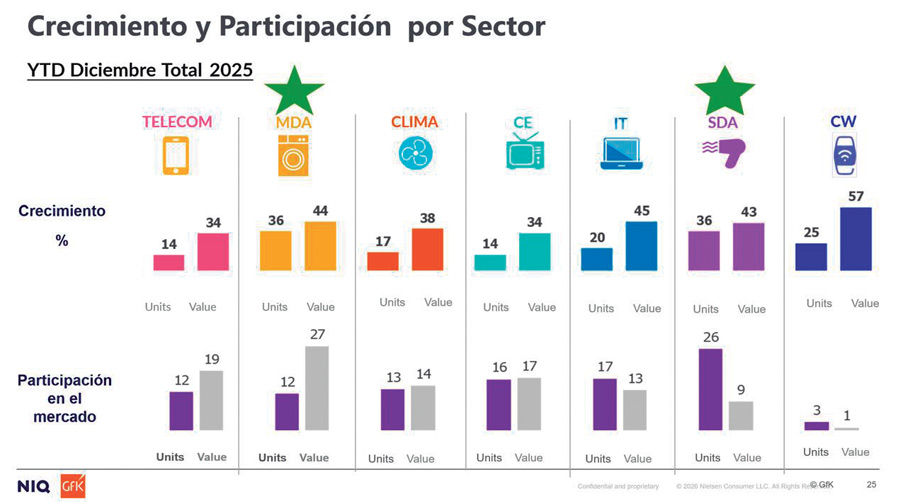
The numbers are eloquent: while the total market for household appliances had a relatively higher sales growth performance than other sectors and businesses of the economy, within it it was categories such as White Line (MDA) and Small Domestic Appliances (SDA) that managed to differentiate themselves above the rest of the product families, which is a reflection that the shock change from the supply occurred greatly in both product families, unlike the rest.
In white goods, the 36% growth in units added to the preponderance of the average ticket allowed us to consolidate this segment as the most relevant within the revenue of the home appliance business. This performance was a reflection of an avid consumer for the product, encouraged by the drop in real terms in prices, more convenient financing conditions and improvements in assortment in terms of the range and variety of models.
Something similar happened with small appliances, which had historically lagged behind in terms of the assortment of various segments and in which the turning point that 2025 represented in terms of commercial opening prompted a good part of the categories, both in the Kitchen and Home Care segments, to show three-digit growth in the first half and then slow down, but maintaining firm demand even until the last month of the year.In white goods, growth of 36% in units, added to the preponderrancidity of the average ticket allowed consolidate this segment as the of greatest relevance within the revenew appliances.
When the look is expanded to the rest of the durables, the contrast arises in terms of volumes and growth evident. Sectors such as IT, telecommunications and air conditioning also reflected a year of recovery, but with different dynamics, where the smaller growth compared to the highlighted ones reflects the fact that the supply via the new import regime, initially described, did not have the same impact and therefore did not change substantially for these product families. in such a way that it leaves us with a market more supported by technological upgrades and range improvements than by pure volume expansion.
On the other hand, categories such as Consumer Electronics (CE) maintained a more moderate evolution, with growth aligned to the average and a relatively stable participation, reflecting a more selective consumer in entertainment products and traditional technology.
The combination of recovery of the salary in dollars of a sector of the population (private in terms of household appliances (fall in their relative price) in the framework of a notable commercial opening, normalization of supply and recovery of bank credit oriented not only to families but specifically to the consumption of durables, allowed categories historically conditioned by scarcity to once again play a central role. The result was not only more sales, but a change in the structure of the market, with clear winners in terms of participation and generation of value.
Looking ahead to 2026, the challenge will be to sustain the volumes of the segments in a context of very heterogeneous dynamics for the various sectors of the economy and therefore the consumption map, where the durable goods industry has drivers and potential to project growth, although more modest than those evidenced in the last recorded period, boosted by the greater purchasing power of wages.



Latest news

LG presented its new washing machine with an innovative urban intervention in strategic lungs of buildings

Outstanding sector