Smart Customer: Data How to know the customer in their real life and minute by minute


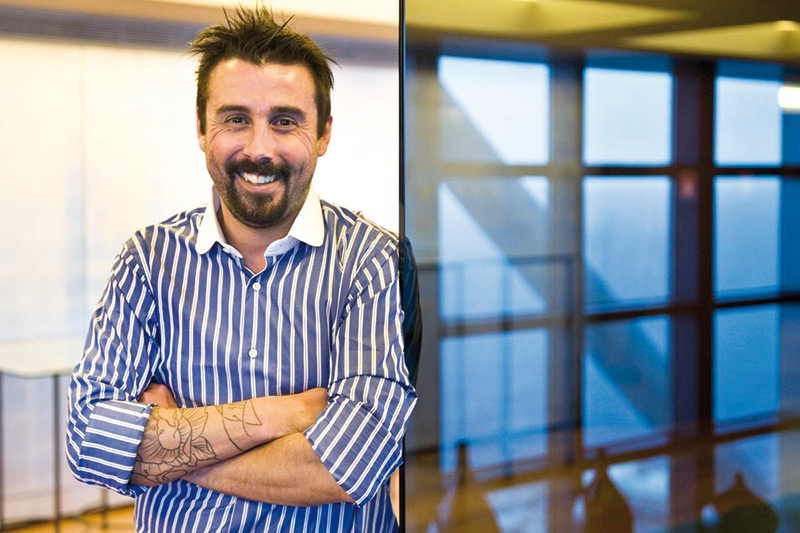
Not knowing the customer's behavior is the first step to making mistakes in your attempts to reach them. Knowing what your real life is like minute by minute throughout the day is the other extreme and Cyprinus acts there, maximizing that knowledge with the aim of improving the CRM and ROI of companies. Silvio Pestrin Farina, its CEO, explains it in this report.
Por Rodolfo Pollini
Cyprinus positioned itself professionally in the world of Smart Customer Data, the study of consumers, but in a special way. How did you get started and what does Smart Customer Data mean in the digital world?
We come from advertising, where we use Smart Customer Data for Telefónica, mainly in Latin America, obtaining minute by minute information about a person's behavior. In the data industry, each person can be three people: the digital person, the browsing person or the Facebook person; There is a transactional person who is the one that the banks can know, because they have insurance or social work and another person in real life, who is the one who takes their child to school, uses the car on weekends and goes to the gym. Using big data and machine learning algorithms, we obtain 175 minute-by-minute attributes of that person and sell them to companies. As the days go by, we become more assertive in these 175 behavioral patterns and when we obtain a rate of 82/83% we tell the company that there is already a degree of certainty.
You claim that 90% of consumer behavior can be predictable for companies. Are we so like that?
People often think it's more unique than it is, but it's more predictable than it seems. It is very simple to put it in a cluster. Many years ago I discovered that people had habits and tastes with very common patterns: fascination with The Little Prince, The Godfather as a movie and The Rolling Stones or U2 in music. The same thing happens with habits.
What differentiates them from other types of tools? I think of Facebook detecting audiences, for example.
We are very good at improving the ROI of companies because we are good at explaining what people are like. It is one thing for an advertising agency to offer you a channel to reach them and another to tell a fast food company that you have a cluster of 72,000 people who consume fast food. We do not sell audiences, we tell companies what their customers are like so that they can make decisions based on that.
How much information or data do they process?
Per million customers we process 30 or 40 billion records, at a rate of 1.44 billion per day per person. The great work we do is that all of this makes sense in drivers that generate value. The Barcelona Super Computing Center is the third computing center in Europe and seventh or eighth in the world. It has nothing to do with a data center, it is much faster and allows us to make decisions in real time.
What happens to them in companies? Do they listen to them and are they prepared to act?
They listen to us. We thought that explaining what we do was going to take us another year, but companies understand that it is no longer useful for them to store volumes of data that they do not have the capacity to process. When we arrived in Latin America we believed that banks were going to consider that scoring was enough for them, but they understand that they must be more assertive and know their client better, so as not to inundate them with information that that client does not care about.
What happens with this but projected to the SME segment?
We are standardizing a service for SMEs. It's good that to bombard me with rackets the digital world knows that I watch Federer or Nadal's matches, but if they saw me in real life they would know that I haven't been on a tennis court for 10 years and I'm never going to buy that racket, even if they offer it to me. The digital flow, where smaller companies can obtain information, lacks knowledge of the real life of their customers and that is where we seek to generate value with a standard model of 10 or 15 indicators, so that smaller companies are also more assertive.
How long has it been since you arrived in Argentina?
Less than a year. We have been working on Smart Customer Data for three years and 12 with a model that distributed advertising, clustering audiences and selling it to agencies. Then came the time of data, which has more value than transactional per se. A mobile wallet, a prepaid card, or any wallet that has no real knowledge of what is going on behind the scenes has no way of knowing you, because you can use that card or wallet no more than twice a day. But if he knows your real life and knows what to offer you at all times, he can make the parallel between how much profit he makes from the transaction and how much he makes from the rest of the data.
I suppose, for results purposes, what they give back to companies as data has a lot to do with their ability to process it and act.
If the company has a million customers, we give it a real photo of that million customers. If you have the capacity to make decisions in real time you will do it, and if you can do it once a day, or a week, too, because we will adjust the focus so that it is more assertive in the 4 or 5 indicators that will be useful to you and that we will return to you according to your ability to process them.
What is the cost for companies?
With three cents a month I follow your client 1,440 times and everywhere: where they are, where they live, where they work, what their tastes are, etc. It is little said like this, but 3 cents on a dollar in a million or two million clients that a bank or a medium to large company may have, are agreements that are around 300 thousand to 600 thousand euros or dollars per year.
Give me an example of the result of what they do but applied, and in real time.
Imagine that you are a beer brand and you ask me to notify you when a person passes within 150 meters of a bar. That process has two parts. One may take a few minutes. The other is a trigger, a trigger that is always activated, which detects by geolocation when a person passes within 150 meters of points already defined on the map, in this case a bar. It notifies you and you can take the action you want in real time, such as sending a 2 for 1 offer on beer one block from where you are at that moment.
Pestrin Flour: "We are very good at improving the ROI of companies because we are good at explaining what people are like. We don't sell audiences, we tell companies what their customers are like so that they can make decisions based on that."



Latest news




Outstanding sector