
SME industry: grew 1.3% annually in September
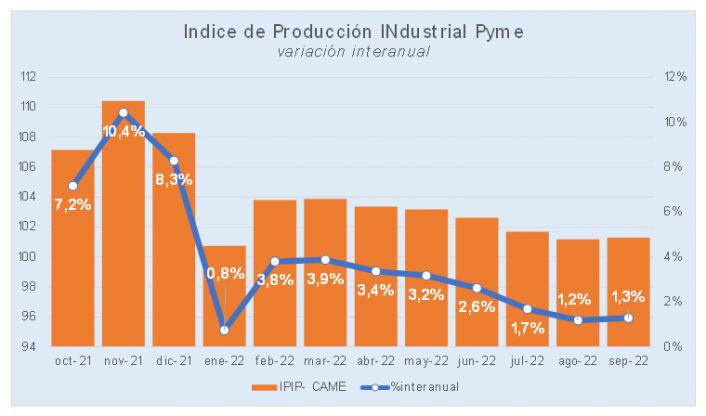
The production of the SME manufacturing industry rose 1.3% annually in September, at constant prices in the interannual comparison, it also registered an increase of around 0.1% in the intermonthly comparison.


The production of the SME manufacturing industry rose 1.3% annually in September, at constant prices in the interannual comparison, it also registered an increase of around 0.1% in the intermonthly comparison. In the accumulated January-September period, the sector also recorded a positive year-on-year variation of 2.4%.
The use of the installed capacity of the companies in the sample was 72.2%, 1.6% above August, with the highest levels in Paper and Printing (77.9%) and the lowest in Metal, Machinery and Equipment, and Transport Material (69.2%). Two thirds of the items surveyed increased the use of their facilities in the month, and the remaining third reduced it.
It is observed that there is idle capacity to increase production, although the lack of inputs and the absence of reference prices slows down investments and decisions to incorporate more personnel. In any case, in the second half of the month, the industries consulted noticed a drop in consumption.
These results arise from the SME Industrial Production Index (IPIP) prepared by CAME, with a sample that reached some 375 SME industries at the federal level.
Sector analysis
The best performance in September was in “Chemicals and Plastics” with an annual increase of 9.8%. The worst happened in “Textiles and Clothing” with a decline of 9.8% in the same period.
1) Food and drinks: Production rose 6.4% annually and 3.3% monthly in September. The beginning of the holidays and events was noted, which increased orders in SME industries such as confectioneries, ice cream parlors, bakeries, pasta production and other foods. The concern of the month was the prices of products such as flour, sugar and vegetables, which upset the costs of many goods, but there are good expectations for December and January. So far in 2022, until September, activity continues to grow by 3% compared to the same months last year.
“The demand for our products is growing and will continue to do so because our main clients are linked to tourism, hotels, restaurants,” said from an SME Paraná in Between Rivers.
Companies in the sector worked with 72.5% of installed capacity, 4.3 points above August.
2) Clothing and textiles. Manufacturing fell 9.8% annually and rose 3.6% monthly in September. The sector works with high levels of its installed capacity, there is little room to further increase production, but profitability, according to the companies consulted, is low. The sector faces wage pressures, permanent cost increases in all inputs and rents. There is a lot of uncertainty, it is the fourth consecutive month that manufacturing has decreased in the annual comparison, although in the accumulated nine months of the year this branch still maintains a growth of 3.4% compared to 2021.
“Production should have improved in September, however, it was very similar to August, this season is very slow, very atypical”commented the owner of a factory in the city of Salta.
The industry worked with 76.7% of its facilities, 0.2 points below August.
3) Wood and Furniture. Manufacturing fell 7.6% annually and also recorded a drop of 8.3% monthly. September was bad, and the exporting firms in the sample agreed that it is no longer profitable to sell abroad. Delays in supplies deliveries continued, there are problems with raw material supplies, both imported and domestic, and volatile prices make it difficult to plan production or establish sales prices for advance orders. There are deliveries that are scheduled for 60, 90, 120 days or more, but prices change week to week, companies warn.
"The previous month we thought that September was going to grow a lot due to seasonality, however, it was almost the same as August, and if we compare it with last year it was a disaster. We don't know how to continue," was the response of the owner of a furniture factory in the city of Tunuyan, in Mendoza.
Companies worked with 75.9% of their facilities, 4.5 points above August.
4) Metallic, machinery, equipment and transport material. Production increased 0.1% annually in September and 0.6% in the monthly comparison. Although there was a slight increase, some of the firms surveyed were concerned about the drop in inquiries and requests for quotes. Furthermore, they expected September to be better than August and that generally did not happen. Problems in obtaining raw materials continued, however, companies are managing and organizing production and deliveries according to what they can obtain. “What is possible is replaced, what is not is expected,” was one of the phrases commented by an industrialist surveyed for this report.
“Sales were weak, but in the coming months they have to rebound,” he said. a producer of electrical transformers Buenos Aires City.
Companies worked with 69.2% of their facilities, 0.4 percentage points more than in August.
5) Chemicals and plastics. Manufacturing rose 9.8% annually and 0.7% monthly in September. The companies had very different results, and the sector lost the firmness with which it had been working. There are concerns about wage pressures and the impact of the new import system on input prices. There are good prospects for the end of the year.
“We were at an international fair and our production orders for this month increased a lot”, said the director of a company that produces oils and creams Villa del Soto, in Córdoba.
The use of installed capacity rose to 70.3%, 5.2 points below August.
6) Paper, cardboard, editing and printing. Production declined 1.1% annually and 9.2% monthly. Many companies were surprised by the month-on-month drop given that September is seasonally usually better than August, and they attributed it to factors such as power outages, strikes and the greater tendency towards virtuality, which was noted in this period, especially in invitations to events. The increase in the cost of supplies such as inks, glues and papers also had an impact, which, according to some SMEs, marked a break in manufacturing orders. In the sum of the year, between January and September, the sector grew 3.7% annually.
“It is very difficult to produce with the constant variation of inputs and the disproportionate increase in paper and just at a time when the printing industry is being replaced by digitalization”, said the owner of a printing press in the town of Lomas de Zamora in the province of Buenos Aires.
The use of installed capacity rose 3.8 percentage points in September, to 77.9%.



Latest news


Outstanding sector