
SME industry: grew 1.2% annually in August
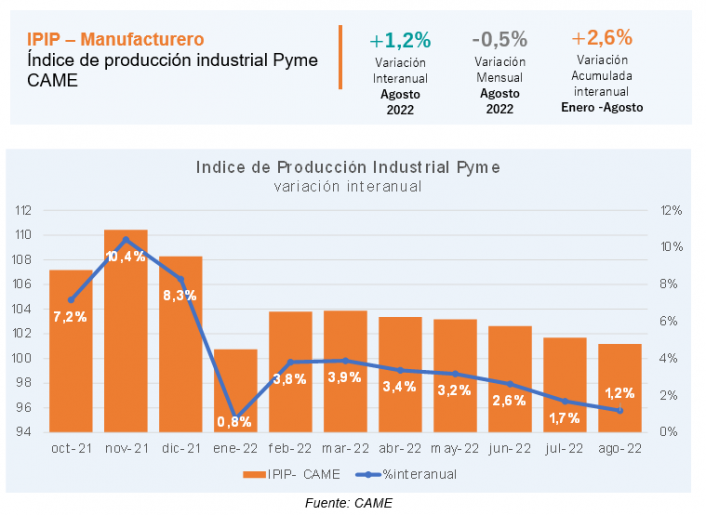
The production of the SME manufacturing industry rose 1.2% annually in August, in real values, and had a decline of 0.5% in the monthly comparison (against July). In the accumulated January-August, it presents a year-on-year increase of 2.6%.


The production of the SME manufacturing industry rose 1.2% annually in August, in real values, and had a decline of 0.5% in the monthly comparison (against July). In the accumulated January-August, it presents a year-on-year increase of 2.6%.
The use of the installed capacity of the companies in the sample was 71.1%, 0.4% below July, with the highest levels in Textile and Clothing (76.9%) and the lowest in Food and Beverages (68.2%). Half of the sectors surveyed increased the use of their facilities in the month, and the other half reduced it. In many cases the decline did not respond to lower demand, but rather to a lack of inputs.
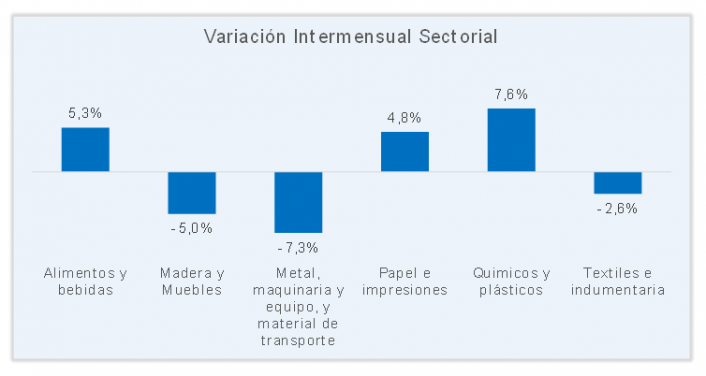
66.7% of the sectors surveyed grew in the annual comparison and 50.0% did so in the monthly comparison.
The results arise from the SME Industrial Production Index (IPIP) prepared by CAME, with observations from 394 industries.
Sector analysis
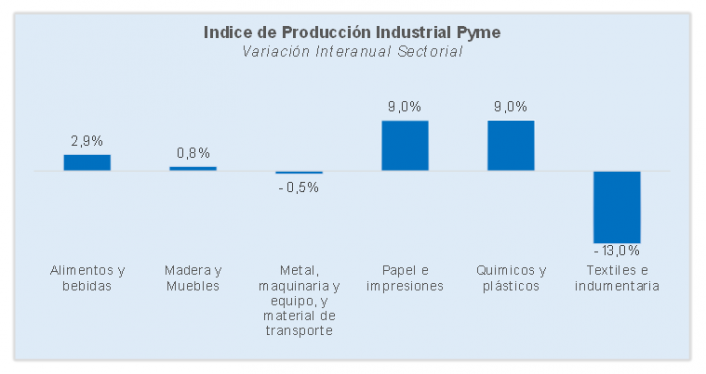
The best performance in August was in two industrial branches: “Chemicals and Plastics” and “Paper, cardboard, publishing and printing” both with an annual increase of 9.0%. The worst occurred in “Textiles and Clothing” with a decline of 13% in the same period.
1) Food and beverages: Production rose 2.9% annually and 5.0% monthly in August. The domestic market, despite the price factor, remains firm, but export companies indicate that they are having more problems placing their products abroad due to lower international demand. Although suppliers were normalizing deliveries, the companies consulted noted that there are shortages and price increases by suppliers continue. Those who use input flour agreed that the product continues to arrive with increases in each delivery.
“We are launching new products, that is why we estimate that our sales will continue to grow very well,” explained an SME dedicated to the production of fresh pasta and bakery and confectionery products from San Salvador de Jujuy.
Companies in the sector worked with 68.2% of installed capacity, 1.9 points below July.
2) Clothing and textiles. Production fell 13.0% annually and 2.6% monthly in August. Businessmen point out that their activity is becoming difficult due to increases in inputs such as threads, printing, fabrics, inks, or latex, among others. Companies face the dilemma that national suppliers raised the price of many inputs by up to 50% from one month to the next, but when they stop buying from them and want to import, deliveries are delayed. There are good expectations due to the proximity of the World Cup. There are textiles that have already started special production lines for that date.
“We recently invested in a new machine and managed to double sales compared to last year, we are doing well,” said the optimistic owner of a clothing factory in Loventuel, province of La Pampa, who managed to escape the general trend of the sector.
The industry worked with 76.9% of its facilities, 5.9 points above July.
3) Wood and Furniture. Production rose 0.8% annually and fell 5.0% monthly in August. The companies agreed that they are working well, but with little profitability, and problems in replacing merchandise due to price increases. In addition, they see less cash on the street and there is concern about the continuity of demand in the coming months. Another problem presented is the payment requirements of suppliers, who demand money at the time of delivery or when placing the order. There are good expectations for the sales generated by the World Cup.
"There are too many difficulties in acquiring imported raw materials, there are supply delays of 180 days. Prices abroad also dropped and that affected our exports," was the response of the owner of a sawmill in the city of Posadas, in the province of Misiones.
Companies worked with 71.4% of their facilities, 5.7 points below July.
4) Metallic, machinery, equipment and transport material. Production fell 0.5% annually in August and 7.3% in the monthly comparison. There were fewer production orders and fundamentally less industrial response capacity due to the lack of two elements: supplies and personnel. July and August were two complicated months operationally. The rise in the dollar generated weekly changes in price lists and many businessmen chose to stretch some budgets. The biggest concern was for suppliers who quote at the blue dollar. In any case, in the sector they affirm that by September the situation would be more normalized, although shortages of raw materials continue.
"Demand continues to increase, but we do not know if we will be able to respond with sales because we do not get raw materials to manufacture. We cannot sell what we want or respond to what they want to buy from us," lamented an industrialist in that sector from the City of Buenos Aires.
Companies worked with 68.8% of their facilities, 2.0 percentage points less than in July.
5) Chemicals and plastics. Production rose 9.0% annually and 7.6% monthly in August. The sector has been working steadily, with increasing orders and many companies with positive expectations because good months for activity are starting. However, companies continue to report that input supply problems slow down their production. The payment chain also began to suffer, “it moves slower” was the most heard comment.
“August was good but we have shortages of raw materials for packaging and an exorbitant increase in the prices of alcohol and propellant,” they warned from a company in Moreno, in the Province of Buenos Aires.
The use of installed capacity rose to 75.5%, 1.6 points above July.
6) Paper, cardboard, publishing and printing. Production rose 9.0% annually in August and 4.8% monthly. The companies consulted indicated that they are producing well, despite the fact that they reopened graphics and there is more competition. This explains the strong investments it is making in the sector to gain competitiveness and offer better prices. There were some supply problems, as is the case with adhesives, which are imported and complicated certain jobs.
“We are building a new plant and buying machines, in August we did very well, but we have a big problem with imports, we are producing with raw materials that we already had, but we cannot replace them,” explained the owner of the printing company from the city of Rosario in the province of Santa Fe.
The use of installed capacity rose 6.0 percentage points in August, to 74.1%.




Latest news




Outstanding sector