Cover note: Interview with Gerardo Presman, Operations & DA Commercial Sr. Director at Samsung Electronics
With Samsung's Director of Operations, we analyzed the profile that the categories produced and marketed by the brand have in the market today and how they are incorporating artificial intelligence, for the connectivity of the products with each other.


I find it interesting to start by analyzing Samsung's profile in national production, and how much it covers within what the company offers in Argentina.
National production started in 2008 and since then we have been developing different partners in Tierra del Fuego for the manufacture of cell phones, televisions, monitors, air conditioners and soundbar; in Buenos Aires, with Visuar, for the production of refrigerators, washing machines, washing machines, microwaves and vacuum cleaners and we have another operation dedicated to notebooks and tablets.
How much is domestic production in the entire brand operation?
95% of the products we sell in Argentina are manufactured locally and 5% of imported products are due to scale, which does not justify amortizing investments. We transfer technology to all our partners so that each of them produces with the quality that Samsung produces anywhere in the world.
During the last years there were many import restrictions and that impacted the supply of inputs and parts necessary for production. How are you seeing that scenario now?
Today import authorizations flow much more and at the level of parts and finished products, foreign trade is much better.
In addition to producing with the same quality as the rest of the world, do we have a market that, due to consumer habits, absorbs all the products that Samsung offers in other countries?
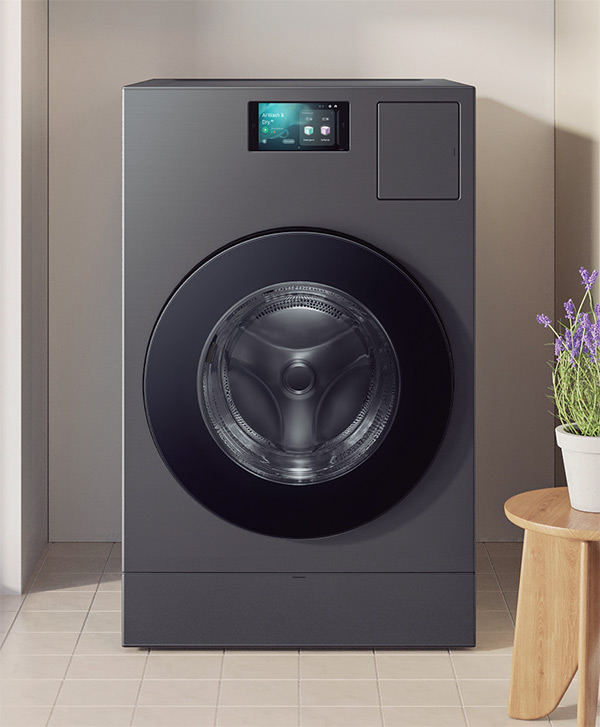
I'm going to talk to you about white goods, specifically. Last year we introduced the first washing machine, as a mass product, with 9.5 kilos of capacity, 6 kilos of drying and the first manufactured in Argentina with Artificial Intelligence (AI). This year we will be bringing a Bespoke washing machine with AI, 22 kilos of washing and 15 kilos of drying and many other functionalities, because we believe that the market is ready to receive products with much more advanced technological complexity.
People want to see these products, but our online sales channel is very important in this category. We sell almost 20% of white goods online, but the point of sale is very important.
What expectations do you have for the coming months, the second semester, specifically?
In white goods this year we did very well. Although the market has fallen, we gained share and we are very happy with our performance. We hope that the second semester will be one of greater recovery.
There is an encouraging sign for these products, which is the financing that during the first months of this year almost did not exist.
It is essential. You will see that in our launches of the Bespoke French Door Family Hub refrigerators and the Bespoke washing machine with AI we are going to have some very attractive offers and, depending on the bank, up to 18 interest-free installments. In addition, the exchange plan for washing machines and, for the first timeRarely, for refrigerators. We are creating a market and going into a segment that almost does not exist in Argentina, the washing machine with 22 kilos of washing and 15 kilos of drying and the Bespoke Family Hub refrigerator with a 32-inch screen. Without a doubt, we want to make life easier for the consumer.
You mentioned a large-capacity washing machine, which was never a common product among us. Obviously they are also committed to changing consumer habits or culture.
With this 22-kilo washing machine, we hope that those consumers who see that these types of products with large-capacity washing and drying are used in the United States will have a different user experience. Today its participation in the Argentine market is very incipient, but we hope to expand it to levels never seen before.
Let's talk about television, a category that is evolving and already has inch sizes installed as a standard that were recently premium, or of a higher level. How do you see the category?
We have an offer for all consumers. After the World Cup the market fell as expected, but the high-inch segment, 60 or more, remained in units. We have televisions up to 98 inches, and in 4K, Qled, Neo Qled, Oled and 8K image quality as an ultra premium product. For example, for gamers we have specific products with different refresh rates, for an immersive experience; and for art lovers, The Frame.
In this category, space limitations may appear in homes, but there does not seem to be much in terms of technological advancement.
Yes, but keep in mind that technology not only has to do with 4K and 8k but also with the consumer's taste in how they want to watch television. Our product The Frame has a matte screen, so the user can view a work of art without reflections. We have OLED for those who prefer more contrasts with blacks and with Neo QLED we offer the same image quality in addition to the connection with SmartThings, which adds a general user experience to the television. The television is going to be like an AI hub and during this year we are going to have an AI launch also for televisions.
How do these technologies participate within the category?
The most basic level is the 4K definition, then we move on to QLED, NeoQLED, OLED and Neo QLED 8K. With AI we can also ensure that much content that is not 4K or 8K can be viewed in this resolution thanks to Upscaling AI technology.
What vision do you have of cell phones, both the category and consumer behavior and what they demand or need from the product today?
After a decrease in consumption in the first half of the year, today we see a recovery with financing that allows the consumer to access the product and the launch offers. Our focus has always been the premium segment. Our new S line products, which we hope to launch in the second half of the year, allow us to say that 2 out of every 3 phones in the premium segment are from Samsung. We are going to fight in this segment and we have tools to do it, with cameras, with design, performance and durability. The main message for the S24 was “the first phone with Artificial Intelligence”.
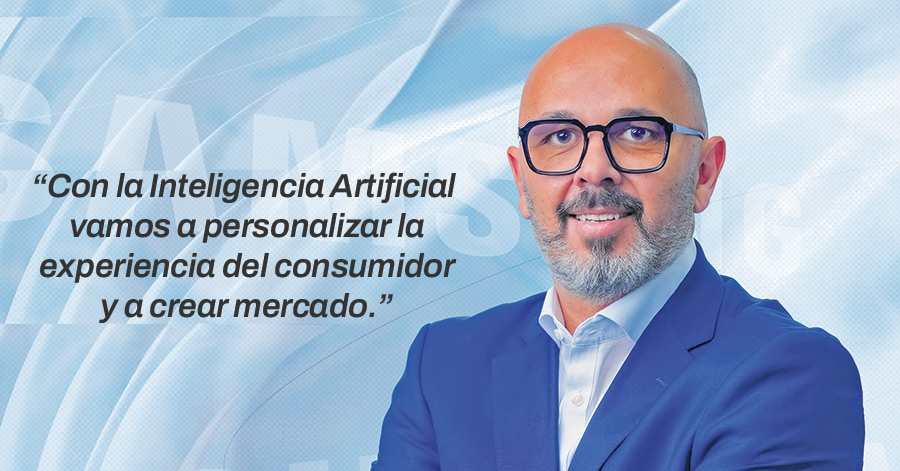
AI is rapidly establishing itself in the daily lives of all of us.
Yes, and Samsung is today the brand with the most interconnected products. Each product reflects our CEO's declaration of having all products interconnected through our own applications and with native artificial intelligence, which is a concept that is here to stay. We have been working in AI for more than 10 years and we are the only company that has a whole range of devices connected to each other.
In addition to these categories, Samsung is also present in others, such as audio, tablets and smartwatches. Tell me something about them.
In audio we have just launched the Music Frame, with excellent market acceptance. It is something totally disruptive, no one ever thought that a painting would have music connected wirelessly and with high fidelity. We are maximizing the category with our soundbars, a line dedicated to premium televisions and a basic one that we produce in Tierra del Fuego. We are launching the Series 7 smartwatch, with the main differential in health care and sleep monitoring, which does not replace the doctor but helps prevent, something highly appreciated by the consumer.



Latest news
Mother's Day: the perfect gift among the diversity of small appliances and the latest launches in personal care.

Outstanding sector