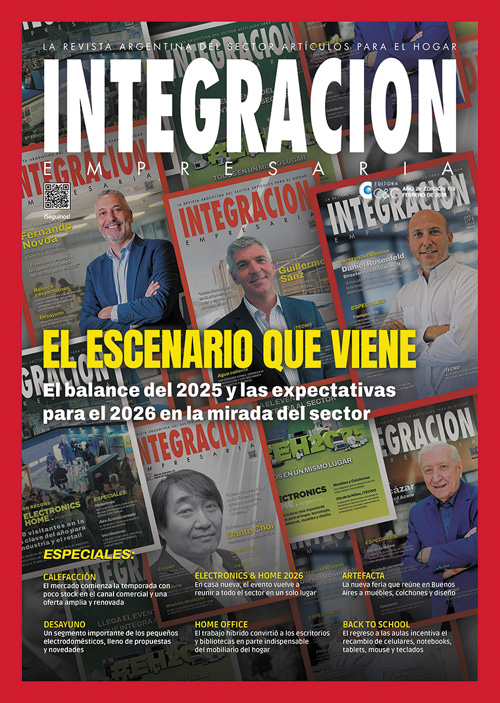
Cover note: Interview with Gastón Marjbein, President of Fag Sistems
With the President of Fag Sistems we talked about the company's positioning, its profile as manufacturers and importers and the impact that changes in the economy and business models are having on the market.



Por Rodolfo Pollini
How long has Fag Sistems been in the market and how many people do they employ?
We have been a company for 23 years now and we have more than 700 people working. On the path that we began 23 years ago, with Kanji, Westinghouse and other brands, our vision was to grow and position ourselves as leaders. Some milestones helped us get to where we are and the most recent was the pandemic, because the consumption of household appliances grew a lot and found us with good stock. Developing the marketing department further also helped to make the brand known, with actions in football, motorsports, on public roads, radio, television and social networks.
In addition to marketing, they manufacture several lines of products.
Yes, a while ago we focused on production. Today we have almost 50,000 square meters between plant, warehouses and logistics, something that served to lower costs. The commercial team also helped us, very present with customers. We are not a structured company, with slow and corporate decisions, we make decentralized, fast decisions close to the client. We win business for that speed, with a small management structure and practically daily meetings.
How did you see this year, which had two very different parts if we consider the post-devaluation on the one hand and, starting in May, the appearance of consumer financing?
The last year for us was very good. The interesting thing was that, having a very bad projection for the beginning of 2024, with an estimated market decline of 40%, we worked with another forecast, we bet on a quick recovery and on some indicators that were going to materialize. That allowed us to capitalize on sales that others did not make. This comes back in practice, because when you attack a niche, you keep part of that niche.
There is a visible impact on the loss of purchasing power of consumers. How do they face this situation, ensuring, I imagine, that the demand is sustained?
In the current context, where money is not enough and the public becomes more intelligent in their purchasing needs, we are a first-price brand with top-quality services, marketing and a commercial department. We make quick decisions and this gives us a very strong advantage over most brands on the market. The middle class, which always focused more on top brands, international or national, is migrating to premium brands, that is our benefit and we are capitalizing on it with almost a 30% increase in units.
How many products make up the offer?
We work with a line of more than 450 products and we have projects to further expand the line.
How do you manage, with a first-price brand and a first-class general and marketing investment, brand positioning and sustaining demand?
There are large transversal companies that cover many areas and others that are dedicated to only one. We are in everything, we have a factory of refrigerators, televisions, small appliances, bicycles, we import technology products and we have a catalog with more than 60 pages. This allows us to subsidize one product with another when necessary, gives us capillarity and the possibility of entering new markets. In any of our customers' shelves you will find many products with the Kanji brand. That's why we make so much advertising investment and so much rapprochement with the customer, with training at the point of sale and ensuring that the product is well displayed.
It has been said for a long time that there are no longer so many strong pre-seasons and at the same time the consumer, depending on their money, buys when they need and if they cannot find it in one place they buy in another. How do you see this scenario?
Preseasons require counterseasons. We are close to the end of the year and in the ventilation and air conditioning season, products that were purchased in March or April, when the market was different, with 40% off and companies that planned their purchases thinking that we were going to continue bad. The proof is that we are in October and there is no air conditioning on the market. This shows that what would have been brought would have been sold. At that time, we went out to pre-sell ventilation and not air, so as not to tie up so much capital, and we found that customers believed that they were not going to sell anything and, furthermore, they had previous stock. The second thing we saw was that in March the interest rate was high, and when you proposed to the client to pay in a very long term and you charged the rate, it was 4 times higher than the previous year. With the devaluation that occurred that was logical, and people did not want to pre-purchase. There our way of seeing things changed, we started thinking about our stock again and not so much about customer sales and we were encouraged to reach 200,000 units. Between the end of May and June everyone began to sell well, they did not know what to do with the money and desperation began. They were selling out of stock, and out of season. Then there began to be pre-sales, to the point that we will surely be close to 500,000 units.
Although what consumers value is the increase in the number of installments they have to purchase, I believe that the important pivot, in general, was the lowering of the interest rate. Do you see it like that?
Yes, it fell a lot and our clients began to think that it is better that we have the stock, because the price will be the same, or less, and with a 2% monthly devaluation and a stable market they prefer that the risk be with the supplier. Speculative purchasing disappeared. Today the customer wants little stock.
Changes in the economy do not only impact prices, they also tend to transform business models. In that sense, what other changes are you seeing?
Another thing that started to happen was that the pricing structures were flattened and we are doing pre-purchase with large clients of all types, something that we did not do before. We have clients who are bringing containers of fryers, conditioners, air conditioners, all types of products in pre-purchase and with a more aggressive model. Clients to whom we bring the merchandise and sell it at the port and others who prefer to make a pre-purchase in China and have us deliver it to their warehouse. In this sense, the market is changing. Going to your question about the changes in pre-purchase, there was a stage in which I believed that all the stock was going to fall on us, but I see that it was not, because clients want volume and the way to obtain it in the medium term is by making projections.
I return to the issue of rate, financing and demand. It was very crazy how we went from the first months of the year, almost without fees and with an unpayable rate, to May, when the Hot Sale exploded, which was a thermometer.
The big change was when the Government told the banks that it was not taking more money from them, as it had been doing with the Lebacs and a financial circle in which the banks were not interested in lending to people, to consumers. Why lend with risk if they could provide the money to the Government at a high rate, without risks and with a single client? When that was over, the rate lowered and the banks went out to do what they have to do: lend to entrepreneurs at a cheap rate with credits and to the consumer through installments and mortgages, which is a driving force.
I relate this to what you said before, that last year's speculative purchasing as a reserve of value for money ended.
What ended up happening is that the product no longer matters, the financial service matters, which is the trend anywhere in the world and in Argentina we had forgotten it. The only thing we did was protect ourselves in merchandise due to the loss of the value of the currency. Today the vision is more intelligent and the opening of the market means that intelligent decisions are also made by others. If I see an electric kettle that I like and I'm not quick, when I receive it everyone is already receiving it.
The Hot Sale not only gave the year a revolution, according to the market, there were real offers that fueled that explosion.
The real or less real offer is more a question of marketing. A moment like this flattens the structures. Today you can decide that you are going to earn 40% on a notebook but you have Mercado Libre, where everyone looks at prices because it is a shop window where you cannot hide and if you list the notebook earning 40% and sell it, not a week passes for someone else to bring it and lower the price. You can get three or four weeks ahead on a price, but no more than that. That's why I don't believe so much in the reality of promotions.
Explain that to me.
When a Hot Sale comes, the most you can do is play with financing, a discount with a card or mix one product with another. Nobody is here to lose money. As I told you before, I can subsidize one product with another, but anyone who only sells one product cannot lose money on that product. When someone sells a product, I go to look at why and a month is enough for me to find that product, I bring itga, I lowered the price and the other supplier ran out of business. Today it's all speed. I'm not saying that people buy only on price. In a Hot Sale there are sure to be offers, but I think that at this moment you have the offer all year round.
Do you see a competition between offline and online or, as many think, a complementation of the two channels?
Several players began to sell directly, but we have a different perception out of respect for the channel, which is our clients. You will never see me offering a product to the final consumer, neither on the platforms, nor on the networks nor with my own stores. It is our client who has to do that last mile.
Let's talk a little about the products. In addition to fryers, which are the stars of the moment, what do you see as most relevant or in which categories do you see a better demand projection in the immediate future?
The air fryer stands out because it exploded. Last year there was a market of 80,000 units and now only we are well above that amount. I think the stage of fryers that are more intelligent in functionality is coming. For us this is the year of washing machines, refrigerators and, in small cases, fryers. The television is already a star product for us and I think that this year we are going to end up with 200,000 units.
Why did you highlight washing machines and refrigerators?
Because they are the two businesses in which we put more focus. In washing machines there were always two players who shared the market, but the openness and ease of importation opened it up for other players and other products, good and cheap. We started with 6 containers to see how we were doing and suddenly we generated pre-sales for almost 30 more containers. With the refrigerators we have a factory but we also import, and today we are bringing in 100 containers. If the market decreased, this means that we took market from other players.
Participating in both the manufacturing and importing of finished products, how do you think the changes that are taking place in the economy and the market impact both activities?
There are fewer regulations for imports. Anyone can import, which doesn't mean anyone is good at it. It requires knowing a lot about the cost structure, which product to choose, having the money, doing the corresponding electrical certifications, going abroad with your own dollars and, in addition, you have to have credit and guarantees. Personally I like everything to be more open because it is also more open for me, and I am competitive.
With respect to manufacturing, there are products that are no longer convenient to manufacture and we are going to move towards products where it is appropriate, such as blenders, hand mixers, irons, fans, air conditioning and televisions. If tomorrow it changes we will see, as happened with microwaves, that now it is advisable to bring them armed.




Latest news




Outstanding sector