The SME cashier is diversifying: 7 out of 10 businesses already use more than one collection solution
Getnet and Somos Pymes launched the first SME Collections Report 2026, an x-ray that shows how small and medium-sized businesses operate today: counters with 2 or 3 collection terminals, digital payments that are growing at scale, and interest in the incorporation of AI in Argentine businesses.


Argentine SMEs continue to transform the way they sell, collect and manage their daily operations. This is revealed by the new SME Collections Report 2026 prepared by Getnet, the leading Fintech in payment solutions in Latin America and Iberia, together with Somos Pymes. They participated in the study more than 500 companies from all over the country, which carry out in-person and digital collections, of different areas and sizes.
"Anything that helps us better understand the needs of SMEs, clients or non-clients of Getnet, is an agenda item for us. This report has the purpose of providing real and federal information about their behaviors, habits and trends when it comes to charging for their businesses. We believe that making the needs of small and medium-sized businesses known is the first way to understand them," said Federico Balige, CEO of Getnet Argentina, Colombia and Uruguay.
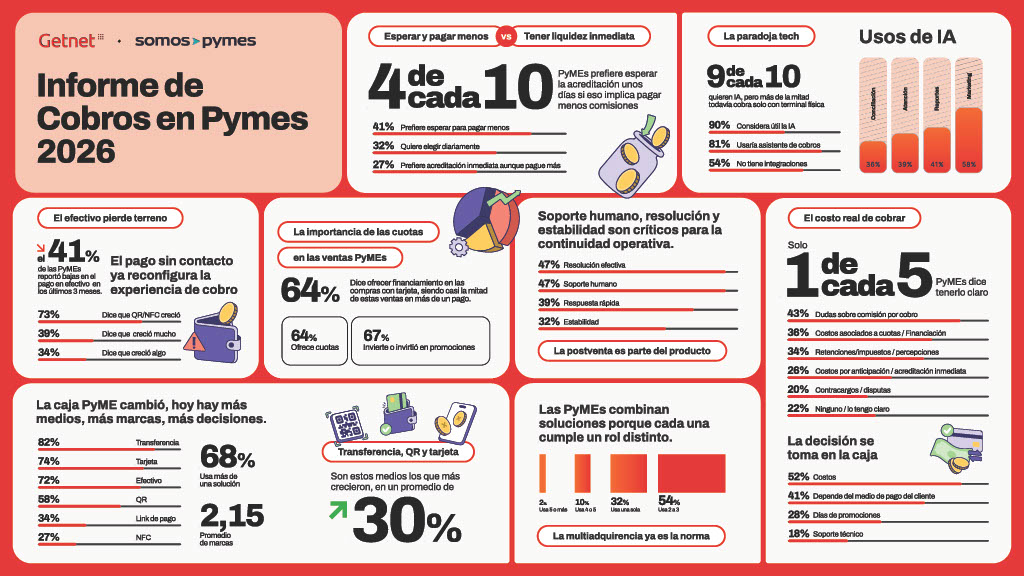
One of the main findings of the report is that the 68% of the SMEs surveyed use more than one collection solution and, on average, operate with 2 o 3 brands simultaneously. This shows that businesses no longer depend on a single tool to collect payments, but rather combine solutions according to cost, the payment method chosen by their customers, available promotions, accreditation periods and the operational need of each moment.
In this new scenario, competition is not only played by being present in the business, but by being the option chosen in each collection.
The SME fund became a complex and diverse ecosystem
The report shows that businesses combine traditional and digital media in their daily operations. Among the collection systems commonly used, transfers stand out, mentioned by the 82% of SMEs; credit and debit cards, with 74%; cash, with 72%; and the QR, with 58%.
In addition, transfers appear as the preferred payment method for customers both in face-to-face and online purchases. In face-to-face sales, 35% of businesses indicate that their customers prefer to pay by transfer, over QR, physical credit card, cash and debit card. In the online channel, that preference rises to 50%.
These data reflect an increasingly hybrid cash register, where cash, cards, transfers, QR, payment links and new contactless modalities coexist.
Contactless payment gains ground
One of the most visible changes is the advancement of contactless payment. He 73% of the SMEs surveyed affirm that payment with QR or NFC grew in the last year. Of that total, 39% maintain that it grew a lot and 34% that it grew somewhat.
This growth confirms that the digitalization of collection does not depend solely on the technological offer, but also on the change in consumer habits. For businesses, accepting new payment methods stops being a differential advantage and begins to become a condition for not losing sales.
Cost defines the daily decision
The research also reveals that cost is one of the most determining factors in choosing a collection solution. Among SMEs that use more than one tool, the 52% He says he decides which one to use on a day-to-day basis based on costs. In turn, 41% choose according to the payment method that the client prefers and 28% according to the days of promotions.
However, the report detects a relevant tension: although costs are central, the “real cost” of charging is not always clear to businesses. He 43% expresses doubts about the collection commission.
This opens a key opportunity for the sector: simplify information, make charges transparent and help SMEs understand how much they charge, when the money is credited and what the total cost of each operation is.
Liquidity: not everyone wants to get paid now, but everyone wants to be able to choose
The accreditation of payments appears as another critical point. He 41% of the SMEs surveyed prefer to wait a few days if it means paying less commissions. On the other hand, 27% prioritize immediate accreditation, even if it implies a higher commission. Between both extremes, 32% prefer to be able to choose the deadline daily, according to the need of the moment.
The data shows that there is no single answer for all businesses. The need for liquidity changes depending on the category, volume, time of the month and the financial situation of each business. Therefore, flexibility in accreditation deadlines is a strategic attribute.
Promotions and quotas are tools to sell more
He 64% of those surveyed offer installments on card purchases, while 67% of SMEs say they currently invest or have invested at some point in promotions or benefits for their customers.
In a context in which businesses seek to sustain sales and adapt to different consumer behaviors, quotas, promotions and benefits are consolidated as key resources to encourage purchases.
After-sales becomes part of the product
When collection is part of the daily operation, the quality of after-sales service becomes critical. According to the study, the aspects most valued by SMEs are effective problem resolution and human support available when needed, both with 47% of mentions.
SMEs look to artificial intelligence, but still operate with low integration
The report also explores the link between SMEs and new technological tools. 9 out of 10 Companies find it useful to incorporate artificial intelligence into their business, and 81% say they would use an assistant that automatically executes collections or reconciliation.
The most valued uses for AI are marketing, with 58%; automatic reports for business monitoring, with 41%; customer service, with 39%; automatic reconciliation, with 36%; fraud alerts, with 30%; and cash flow prediction, with 24%.
But the enthusiasm coexists with a still incipient operational reality: 54% of the SMEs surveyed claim to have no integrations and operate only with physical terminals.
The challenge is not only to offer innovation, but to translate it into simple, concrete solutions applicable to daily operations.
"The study shows us that the SME box has become a strategic decision space. Businesses combine solutions, compare costs and look for tools that allow them to operate with greater clarity and efficiency. The opportunity is to transform this data into concrete solutions that simplify the daily lives of SMEs," said Damian Bulfon, Head of Marketing & Communications LATAM at Getnet.
"At Somos Pymes we work hard every day to bring more opportunities, tools and meetings for small and medium-sized companies throughout the country. Through this study we can better understand what needs our strategic segment has and how to help them, together with Getnet, to sell more and better," pointed out Christian Datola, Founder and CEO of Somos Pymes.
Getnet: a well-known, used brand with the opportunity to deepen its role in the SME box
Within the evaluated set, Getnet shows a relevant level of knowledge and use. The study indicates that 83% of the SMEs surveyed heard about Getnet, 44% affirm that they use it and 39% that they know about it, although they do not use it.
Among those who use Getnet, the most valued benefits are immediate accreditation, with 41%; the collection options that adapt to the business, with 34%.
A first report to understand a structural transformation
The presentation of this first report by Getnet and Somos Pymes provides evidence of a transformation that is affecting thousands of businesses. Charging is no longer an isolated operation, but a strategic decision that impacts sales, costs, liquidity, customer service and business management.
The results show that collection solutions have a clear opportunity to stop being seen solely as transactional tools and become allies to organize, enhance and make the daily operations of SMEs more efficient.
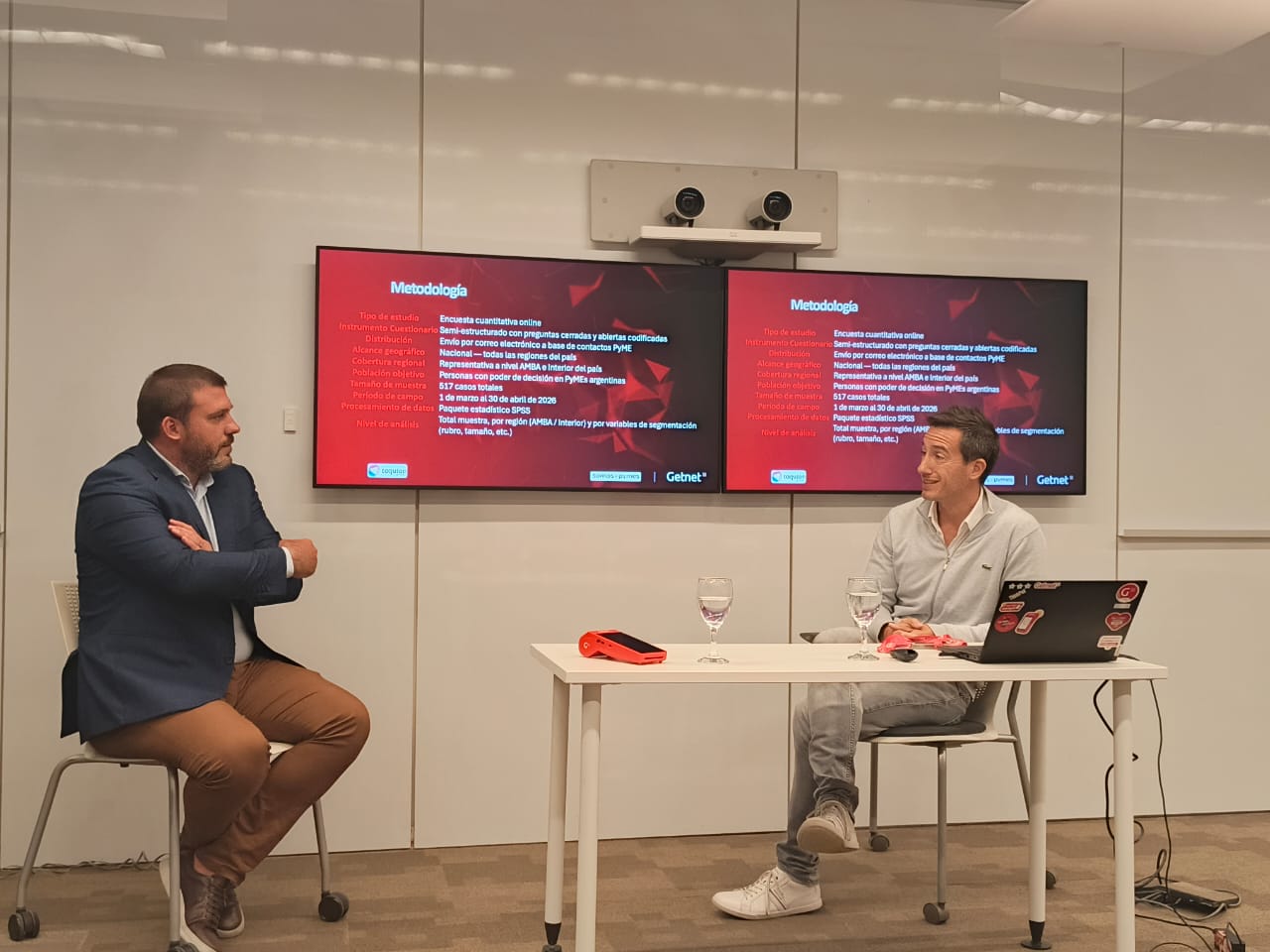
The study was presented by Getnet and Somos Pymes. The research was carried out online, through email and digital media, with national reach. The population surveyed was made up of people with decision-making positions in SMEs. The sample size was 517 total cases and the field work was carried out between March 1 and April 30, 2026.




Latest news

Outstanding sector