Children's rooms: fewer meters, more furniture solutions
How to solve a children's room when the available space is increasingly limited? How to make rest, study, play and storage coexist without overloading the environment? Changes in housing are driving new furniture alternatives and opening opportunities for the channel.


Children's and adolescents' rooms are no longer spaces intended solely for rest. In many homes, the same room must function as a bedroom, study space, play space, and storage area. Added to this is an increasingly present reality: reduced surfaces that force us to rethink distribution and equipment.
This scenario is also modifying the offer of children's and youth furniture. The trend is towards products that combine functions, incorporate storage solutions and can adapt to different stages of growth.
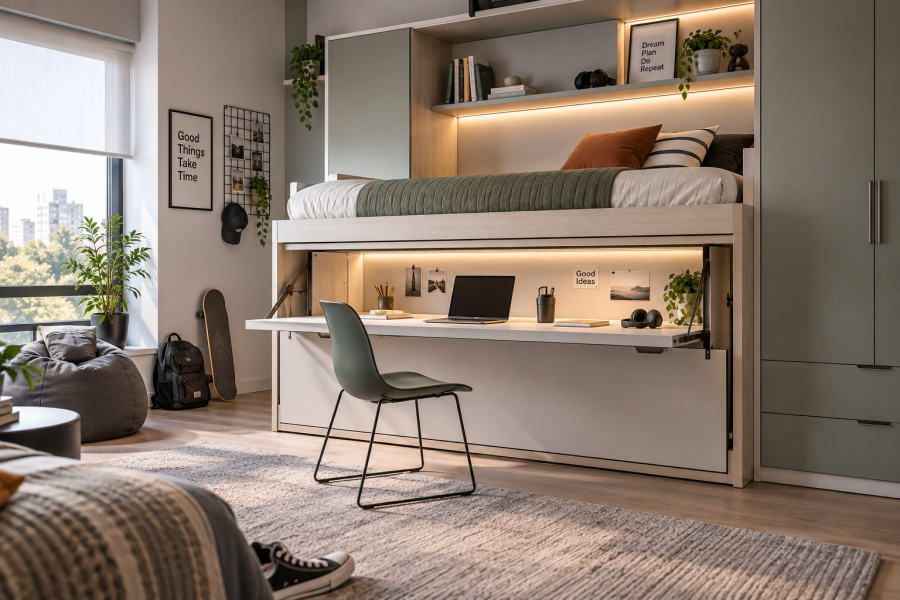
Among the alternatives that appear most strongly are the raised or loft beds, which use the lower sector to incorporate a desk, a library, a closet or a play space. The structure stops being just a bed and becomes an integral solution for the environment.
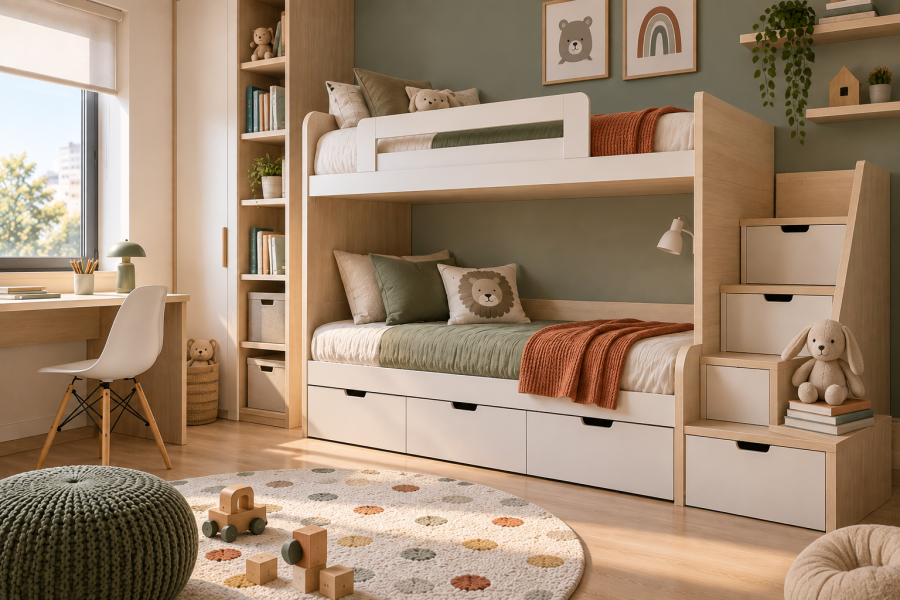
In shared rooms, multifunction bunk beds offer a similar answer. Drawers, shelves, desks and storage modules are added to the two resting places, concentrating different needs in a single structure.
Also the trundle beds They allow you to better manage small spaces. The second bed can be stored during the day and used when needed, while other designs incorporate drawers or compartments at the bottom.
The study area poses another challenge. Instead of adding an independent desk, some proposals integrate it into libraries, closets or bed structures. The folding or folding desks They also offer the possibility of recovering surface once the activity is finished, a particularly useful feature in small bedrooms.
The need to accompany the growth of children is also favoring the modular and convertible furniture. Systems that can be reorganized, expanded or modified in configuration allow the bedroom to be adapted to new needs and extend the useful life of the product.
Storage occupies a central place in this context. Drawers under the beds, vertical modules, raised shelves and closets with different configurations allow you to maintain order and increase the available capacity without incorporating a large number of pieces.
An opportunity for the channel
For manufacturers, importers and businesses, these changes represent an opportunity to rethink the category's proposal. The consumer does not necessarily seek to add furniture, but find solutions that respond to different needs within the same environment.
In this context, offering complete proposals can become a differential. A bed with storage and a desk, a multifunction bunk bed or a modular system that accompanies different stages of growth allow us to go from the sale of an individual product to a proposal designed to solve an environment.
It also opens up space to work with different configurations, measurements and levels of equipment, expanding the possibilities of choice according to the characteristics of the bedroom and the needs of each family.
The evolution of children's furniture thus shows a transformation that goes beyond design trends. The search for greater functionality is leading manufacturers and businesses to develop more flexible and adaptable proposals., capable of responding to different stages and forms of use.
For the channel, the challenge will be to accompany this change with an offer that is not limited to covering a specific need, but also provides answers for increasingly multifunctional environments. In a market where the dimensions of homes determine purchasing decisions, The ability of a piece of furniture to fulfill different roles can become one of the main attributes of the category.



Latest news

Outstanding sector