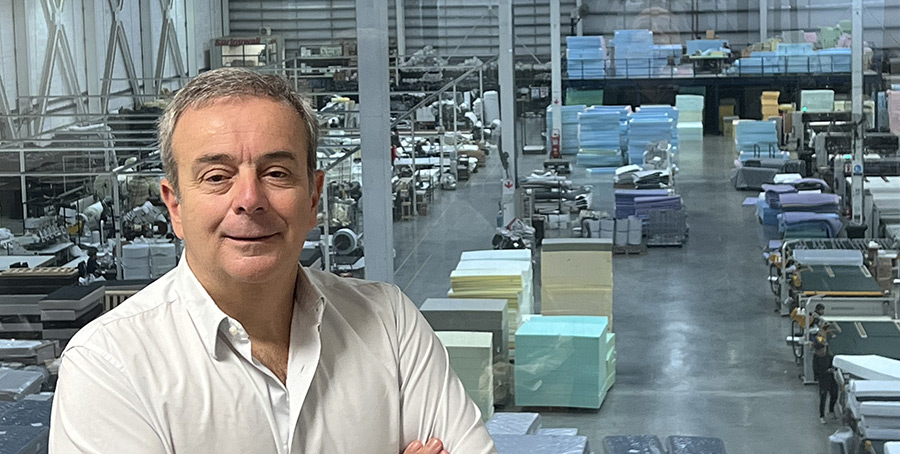
Interview with Javier Vázquez, President of Springwall. “Our bet is on consolidating leadership in the medium-high segment.”
We spoke with Javier Vázquez, President of Springwall, about the company, the impact of technology on products and the demand profile and marketing channels.



Por Rodolfo Pollini
What is the current composition of the market in terms of participation by type of product and user preference?
Today the Argentine mattress market is roughly divided into 40% corresponding to spring mattresses and 60% to foam products in their different variants: conventional, viscoelastic, high-density foams and hybrid combinations that incorporate layers of different materials. It is a market that has evolved a lot in recent years. Before the equation was almost exclusively springs versus basic foam; Today, foam has gained ground with very solid technical proposals that especially seduce a consumer who values the adaptability of the product to their body and who seeks immediate comfort. In any case, springs continue to be the preferred choice when advice is involved, something that at Springwall we always highlight: a well-explained product sells itself.
At what rate is the market growing annually?
Historically, the mattress market grew at a rate correlated with the vegetative growth of the population, which made it a predictable market. But in recent years we began to see new factors that accelerate this dynamic. Longevity is one of them. There are more older adults who require specific rest solutions, and that opens up a very interesting segment. Furthermore, the divorce rate in Argentina has grown steadily, which implies that the same family unit generates two new needs for home equipment. And then there is something that makes us proud as an industry: the awareness of good rest. Today people understand that sleeping well is health, it is productivity, it is quality of life. This cultural change is perhaps the most powerful growth driver we have for the coming years.
What percentage of sales is channeled through home retail, the specialist channel and online?
The distribution of the market by channel is quite balanced and, at the same time, very revealing of the moment we are experiencing. Today, household goods retail accounts for approximately 50% of sales, which continues to position it as the dominant channel. Mattress specialists, with a more focused proposal and a much higher level of advice, represent around 25%. And the online channel, which even A few years ago it was almost marginal, it now reaches the same remaining 25%. This last piece of information is very significant: in a category where historically it was said that no one would buy a mattress without trying it, e-commerce found its place. The mattress in a box was the great facilitator of that leap. At Springwall we have been betting heavily on this coexistence of channels, with proposals adapted to each one.
How do imports or global brands have an impact, in historical terms and based on the recent conditions of economic openness?
The incidence of imported mattresses in the Argentine market is, for now, relatively low. Some products are observed from China and Brazil, but without major impact on the participation of local brands. The recent economic opening logically raises questions, but there is something very clear in our favor: the Argentine consumer has high loyalty with the local brands that they know and that have generated trust over time. A Chinese or Brazilian brand without history here has a very long way to go. What we do find important to highlight is that the possibility of importing inputs allowed us to level out production costs, which is a huge competitive advantage. We can manufacture top-notch products at competitive prices, and that is something we value highly going forward.
How do you see the perception that the consumer has regarding the mattress in a box, or a roll-up mattress?
The roll-up or box mattress experienced an adoption curve in Argentina very similar to that experienced by the most mature markets in the world, although with its local particularities. At first it aroused skepticism, especially among older generations, who could not conceive of buying a mattress that arrived compressed in a box. But young people quickly adopted it, and with good reason: it is a perfect solution for those who move to a small apartment, for those who buy online, for those who value practicality without sacrificing quality. Today that initial skepticism practically disappeared. The tested product convinced, and word of mouth did the rest. At Springwall we have mattress-in-a-box lines that have grown well above the average for our portfolio, and that speaks for itself.
What factors influence the consumer's decision between foam and springs?
This is one of the data that impacts us the most when we analyze it in depth: when the consumer receives genuine advice, the choice for spring mattresses is practically systematic. And this is no coincidence. The springs offer a combination of breathability, differentiated support by body area, durability throughout of time and comfort that foams, in general, still cannot match as a whole. The problem is that a good part of the sales occur without that advice: the customer comes in, sees the price, touches the mattress for a second and decides. In that scenario, foam has initial feel and price advantages that work in its favor. That is why at Springwall we invest a lot in training the sales force at the points of contact: a well-trained salesperson is the best tool we have.
The consumer or user of mattresses always had little knowledge about mattresses. You know you want to sleep well and not much else. Is that still a constant in demand or are factors such as networks and digital marketing changing the context?
That constant of low consumer awareness is breaking, and faster than many in the industry expected. Social networks, wellness influencers, health podcasts and sleep medicine content are generating a much more aware and informed consumer. Today people arrive at the point of sale knowing what a pocket spring mattress is, what memory foam is, and how firmness impacts the back posture. It is excellent news for brands that we have quality products to offer, because the informed customer values the differential and is willing to pay for it. At the same time, it forces us to keep up: digital marketing and educational content have become strategic tools that we cannot neglect.
Exposure in commerce, due to the size of the products, is another issue. Does it cover what the suppliers would like as an ideal for the user and at the moment he enters the sales premises to consult and choose?
It is an outstanding debt of the retail channel, and I say it very clearly because it is something that has worried us for years. The mattress is a product that requires space, lighting, and contextualization. So that the customer can feel the difference between one model and another, so that the seller can give a real demonstration of the characteristics of each one, square meters are needed that large retailers simply do not allocate. The mattress section is often squeezed between appliances and other household items, without the attention that the category deserves. Specialists do do it well: they have the right environment, trained staff and the time to accompany the client's decision. That is why the 25% that the specialist channel has has enormous strategic value for premium brands like Springwall.
This is a market with great price dispersion. How do you classify it by price segments in general and with what share of sales volume each one?
The market is divided into three clearly differentiated segments, and each one responds to a different consumption logic. The low range concentrates approximately 40% of the volume: they are entry-level products, generally low-density foams or simple springs, where the price is the determining factor and the margin for the brands is very tight. The mid-range is the most dynamic and represents around 50% of sales: here the consumer begins to value attributes such as durability, differential comfort and the guarantee of a recognized brand. It is the battlefield where most of the business is defined. And the high range, with 10% of the volume but with much higher margins, is where the most technologically advanced products are: individual pocket springs, memory foams, technical fabrics. Springwall has a presence in all three ranges, but our commitment is to consolidate leadership in the medium-high segment.
How is the Argentine market in terms of replacement frequency and type of consumption in relation to other countries?
Compared to mature markets such as Europe or the United States, where the replacement of a mattress occurs on average every eight years, in Argentina this frequency has historically been much higher: many people use their mattress for ten, fifteen or more years, often without being fully aware of the damage that this causes to their rest and their health. This is, at the same time, a structural limit of the market and a huge opportunity. The challenge for the next few years is to educate the consumer about the real lifespan of a mattress, about how to recognize when your product is no longer providing the support you need. If we manage to shorten this replacement cycle even slightly, the impact on the market would be very significant. It is a long-term work, which combines communication, education and generation of awareness, but we are convinced that it is the way.
Where are the main developments that technology can bring to this market happening today, or do they aim to happen soon?
Technological innovation in the mattress industry is advancing on several fronts simultaneously, and we are very excited about that. In the world of springs, the evolution towards individual pocketed systems, where each spring works independently, marked a turning point in terms of support and elimination of movement. Smart fabrics with thermal, moisture-regulating and antimicrobial properties are another very powerful line of development. Special high-density foams and memory foams continue to gain ground in sales. But the most disruptive change in recent years is the mattress in a box: it transformed the logistics of the sector, drastically reduced freight costs, freed up space in warehouses and opened the online channel in a way that until recently seemed impossible for this category. At Springwall we are very active in all these lines of development.



Latest news


Outstanding sector